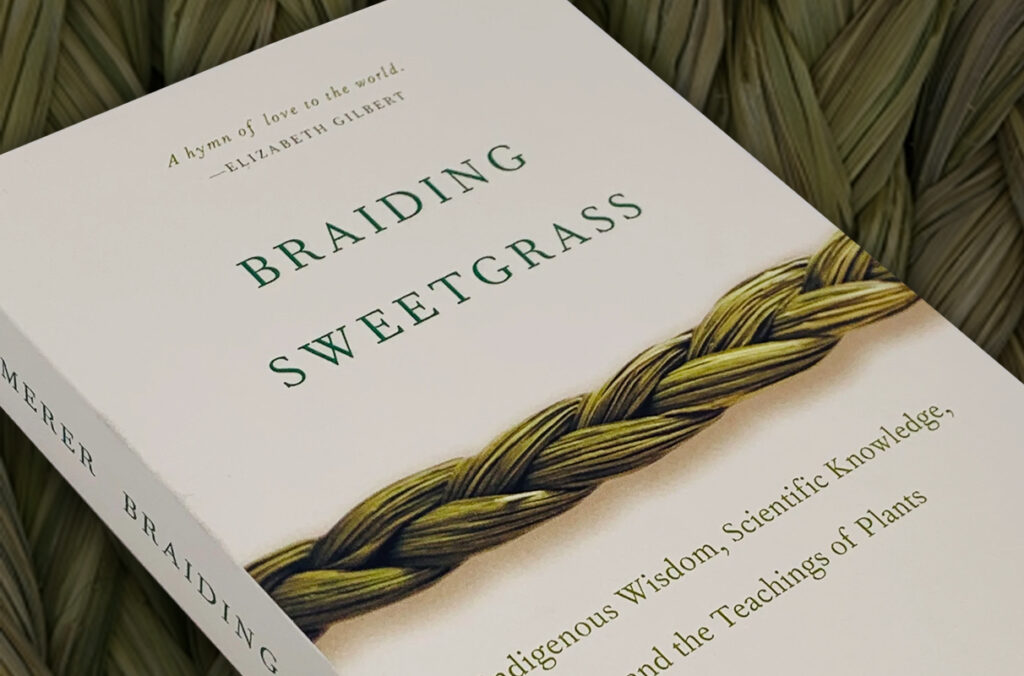
I started reading Robin Wall Kimmerer’s ‘Braiding Sweetgrass’ during lockdown, when the world seemed dark and the days were endless monotony of bad news. I had read her other book ‘Gathering Moss’ during a period of immense grief and feel like I had my perspective on life permanently changed after that. ‘Braiding Sweetgrass’ is hardly a difficult read but my own ability to stick to books over the last few years has ebbed and flowed. This winter I finally picked it up again and began to slowly pick away at it. One of the difficulties I had in finishing it, was that there is just so many ideas and examples crammed into the book. Each chapter is rife with reflections on systems that nurture and oppress us and has so much to think about, I often felt like I needed a nap each time I put it down.
One idea that I think Kimmerer returns often, is the way that our growth models and consumption is simply unsustainable. Climate and food security will not come from EVs, solar panels, or a patchwork of government regulation, but a complete overhaul of our systems as well as our own sense of ourselves and our place in the world. In particular, Kimmerer pulls apart notions of scarcity and how they are created and enforced by our current systems:
“In an essay describing hunter-gatherer peoples with few possessions as the original affluent society, anthropologist Marshall Sahlins reminds us that, “modern capitalist societies, however richly endowed, dedicate themselves to the proposition of scarcity. Inadequacy of economic means is the first principle of the world’s wealthiest peoples.” The shortage is due not to how much material wealth there actually is, but to the way in which it is exchanged or circulated. The market system artificially creates scarcity by blocking the flow between the source and the consumer. Grain may rot in the warehouse while hungry people starve because they cannot pay for it. The result is famine for some and diseases of excess for others. The very earth that sustains us is being destroyed to fuel injustice. An economy that grants personhood to corporations but denies it to the more-than-human beings: this is a Windigo economy.”
Kimmerer. Braiding Sweetgrass. 376
I have been thinking about this a lot. There is so much work and so much that needs to change and it often feels impossibly daunting. But viewing the world through different lenses is immensely liberating. To view food, community, and care as things that can in fact be abundant if re-prioritize, is something we can actually impact and achieve. The idea that we can only buy or spend our way out of crises is a cornerstone of late stage capitalism. Nearly everyone I talk to, regardless of their personal or political beliefs, feels this aching scarcity and long for something better. What are some ways you are re-prioritizing and cultivating abundance?



 Last Ditch
Leave a comment