As the trade war between the US and Canada (and everywhere) continues to twist and turn with the bloviations of an authoritarian, in Canada we have responded by electing a Liberal government running on the promise of “standing up to Trump.” As we have all found out since the election, the oil and gas industry and their investors in Canada have not wasted the moment to push deeply unpopular pipelines as the solution to Canada’s trade woes. The argument goes that opening more overseas and cross Canada oil markets, that will make up for the loss in exports to the US. The climate crisis, despite it worsening dramatically across the country, has fallen completely to the wayside. As swathes of entire provinces burn, their elected officials continue to tout pipelines as the solutions to all our problems.
The one major snag with this of course is that the world needs to dramatically decrease the burning of fossil fuels. We have already locked in a large degree of climate catastrophe. I rarely hear that acknowledged but our current course is already dire, even if emissions were to plateau. And as yet another screaming canary in our dirty little coalmine, the mass extinction of insects is portending a world that is truly unlivable for humans. Why? I’ll let the biologists studying this mass extinction explain:
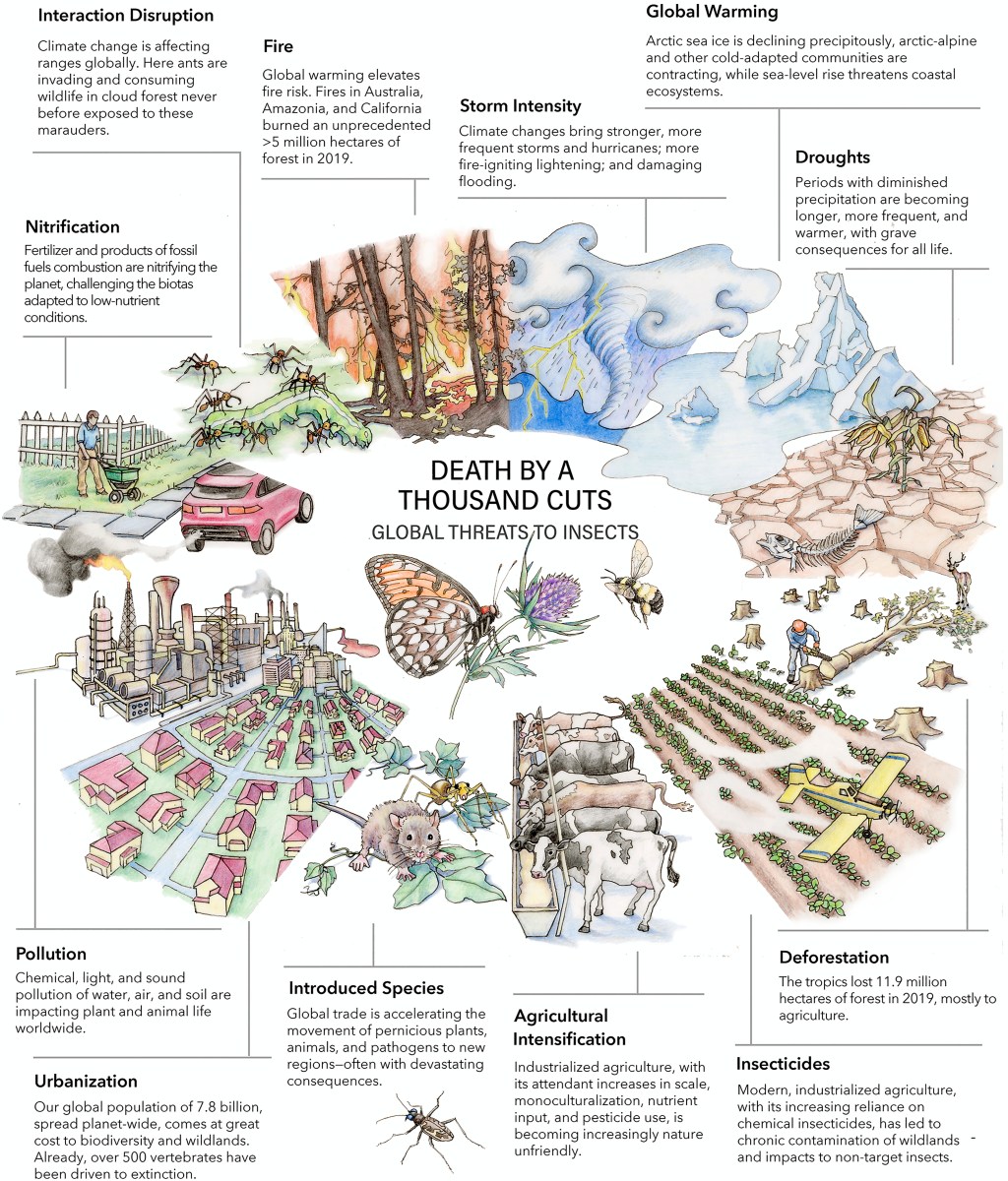
“Insects comprise much of the animal biomass linking primary producers and consumers, as well as higher-level consumers in freshwater and terrestrial food webs. Situated at the nexus of many trophic links, many numerically abundant insects provide ecosystem services upon which humans depend: the pollination of fruits, vegetables, and nuts; the biological control of weeds, agricultural pests, disease vectors, and other organisms that compete with humans or threaten their quality of life; and the macrodecomposition of leaves and wood and removal of dung and carrion, which contribute to nutrient cycling, soil formation, and water purification. Clearly, severe insect declines can potentially have global ecological and economic consequences.”
– Insect decline in the Anthropocene: Death by a thousand cuts
We depend on insects. Nearly every life giving process that humans need to exist on this planet is made possible or is greatly enhanced by them. A world without insects is a world without food for humans. And this decline is not new. The trouble is, it’s getting much, much worse:
A few percentage points a year may not have the ring of disaster. “But if you run that forward just four decades,” Wagner says, “we’re talking about nearly half the tree of life disappearing in one human lifetime. That is absolutely catastrophic.”
– ‘Half the tree of life’: ecologists’ horror as nature reserves are emptied of insects
So, it’s not great. But at Last Ditch I’ve committed to trying to find solutions. Here are a few main things that emerge when I looked into what would actually address this issue:
- Dramatically reduce pesticide use. The dark irony of mass sprayed insecticides on human food crops is that they are largely indiscriminate and kill everything in an ecosystem. We must work with farmers for viable solutions, like:
- Use alternatives to pesticides. This isn’t a one size fits all solution but there are many approaches to food growing and farming that can eliminate the need for insecticides. Crop rotation, reducing or eliminating tilling, not relying on large scale single crop farming, and promoting habitats for beneficial insects and birds can all work extremely well.
- Policy change. While these might be bleak political times for progressives (or anyone with a pulse), we must campaign for effective regulation and control of pesticides and farming. Farmers have been hit hard by compounding crises but the mass extinction of insects is one they’ll never bounce back from. At the same time, we can’t expect independent farmers with already razor thin profit margins to shoulder the burden. Large corporate farms (the majority) must pay into programs that promote better practices and help smaller farmers.


 Last Ditch
Leave a comment